Ultrasonic welding is a solid-state joining process that applies high-frequency ultrasonic acoustic vibrations to workpieces clamped together under pressure. This advanced technology is compatible with both plastic and metal welding, enabling the bonding of diverse materials. When applied to metal welding, the processing temperature remains below the melting point of the base materials, preserving the original physical and chemical properties of metals better than high-temperature traditional welding methods.
Requiring no bolts, nails, adhesives or additional welding fillers, ultrasonic welding serves as an efficient and eco-friendly joining solution. It has been widely adopted across core industries including automotive, aerospace, medical devices and electronics manufacturing.
The technology originated in 1963, when Robert Soloff and Seymour Linsley discovered the ultrasonic welding effect for rigid thermoplastic components. Soloff accidentally found that an ultrasonic probe could bond two halves of a plastic tape dispenser. He further confirmed that ultrasonic energy could penetrate and bypass rigid plastics to form complete welding joints, which laid the foundation for the first ultrasonic welding press. The two inventors were officially granted the patent for rigid thermoplastic ultrasonic welding technology in 1965.
In the early stage, ultrasonic welding was only capable of joining rigid plastics and was initially applied in the toy manufacturing industry. In 1969, the first all-plastic car was assembled using ultrasonic plastic welding technology. Although the automotive industry later abandoned the all-plastic vehicle design, it continued to leverage ultrasonic welding, which gradually gained popularity in various industrial sectors.
Ultrasonic Welding Process & Core System Components
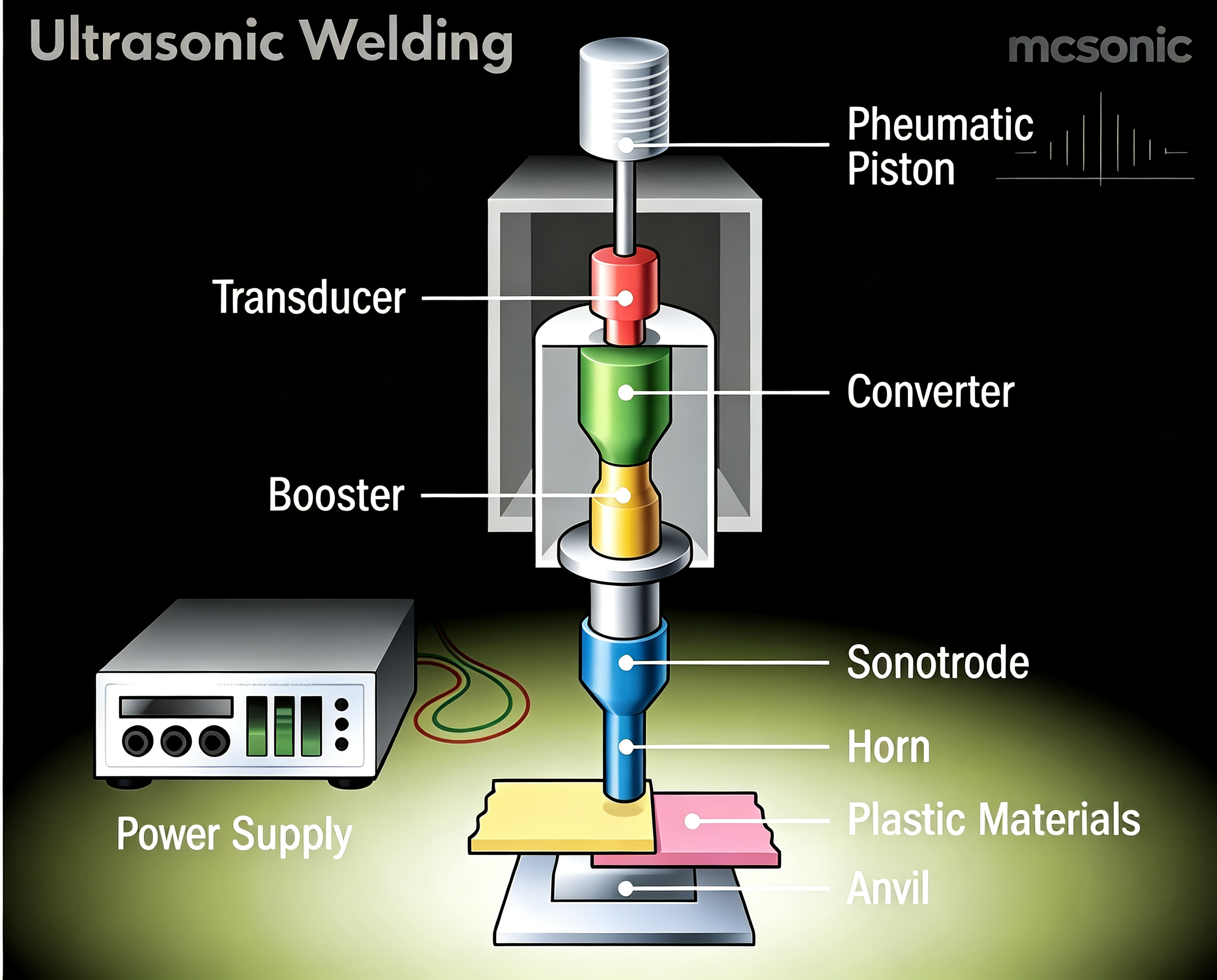
Ultrasonic welding can bond rigid and soft plastics as well as various thin-layer metals, with a unified basic working principle. All standard ultrasonic welding systems consist of the following core components, ensuring stable and precise welding performance:
1. Press & Positioning Fixture
Driven by electric or pneumatic power, the press provides stable clamping pressure for two workpieces. Anvils, fixtures or custom nesting tools are used to fix parts and guide high-frequency vibrations accurately to the welding interface.
2. Ultrasonic Working Assembly (Transducer, Booster & Sonotrode)
This core vibration unit determines welding accuracy and stability:
Transducer: Converts electrical signals into mechanical vibrations through the piezoelectric effect, the core source of ultrasonic energy.
Booster: Mechanically adjusts the amplitude of vibrations and transmits clamping force to the welding equipment.
Sonotrode (Welding Horn): Delivers adjusted ultrasonic vibrations to the workpiece surface, fine-tunes vibration amplitude and adapts to different part shapes for targeted welding.
All components of the ultrasonic assembly are tuned to resonate at the same ultrasonic frequency for consistent energy output.
3. Ultrasonic Generator & Controller
The ultrasonic generator outputs high-power electrical signals matching the system’s resonant frequency. The intelligent controller precisely regulates press movement, ultrasonic energy transmission, welding time and pressure, realizing automatic and standardized welding operations.
Ultrasonic welding equipment supports customized configuration for diverse workpiece specifications. The general working flow is as follows: Workpieces are fixed in the nesting fixture and clamped by the press; the sonotrode contacts the parts and delivers high-frequency vibrations; the interface materials melt locally and form a firm bond. Common ultrasonic welding frequencies include 15kHz, 20kHz, 30kHz, 35kHz, 40kHz and 70kHz, covering most industrial welding scenarios.
How Does Ultrasonic Welding Work? (Plastic vs Metal)
While the core system structure of ultrasonic welding remains consistent, the bonding mechanisms for plastics and metals are fundamentally different:
1. Thermoplastic Welding Mechanism
The welding interface of plastic workpieces is usually designed with spike or circular contact structures to concentrate vibration energy. Under high-frequency ultrasonic vibration, the tiny contact points generate instantaneous frictional heat, causing local melting of the thermoplastic material. Vibration energy is evenly absorbed along the welding joint, achieving localized and precise melting without damaging the non-welding areas, and forming a seamless and sturdy bond after cooling and solidification.
2. Metal Welding Mechanism
Metal ultrasonic welding relies on high-pressure diffusion of surface oxide layers and micro material movement induced by ultrasonic vibrations. Although the process generates slight frictional heat, the temperature is always lower than the metal’s melting point. This solid-state welding mode avoids material deformation, metallographic structure changes and performance degradation caused by high-temperature welding.
In addition, ultrasonic welding technology can also form highly durable bonds between carbon fiber-reinforced polymer (CFRP) sheets and light metals. Relevant technical research is still being optimized to further improve welding quality and parameter adaptability for industrial mass production.
Key Advantages of Ultrasonic Welding
Compared with traditional thermal welding, adhesive bonding and mechanical fastening technologies, ultrasonic welding has outstanding industrial advantages:
Low-Temperature Welding & Wide Material Compatibility: The low heat-affected zone avoids thermal damage to materials, supporting the welding of various sensitive and composite materials. It reduces energy consumption and production costs with lower power requirements.
Ultra-Fast Welding Efficiency: The whole bonding process can be completed in a fraction of a second. Unlike adhesive bonding, no long curing or drying time is required, greatly improving production cycle efficiency.
Safe & Eco-Friendly: No open flame, flammable fuel, chemical solvents or consumables are needed during operation. It produces no harmful gas or pollution, ensuring a safe working environment and meeting green production standards.
Automated & Precise Production: The process supports full automation, delivering clean, repeatable and high-precision welding joints with minimal post-weld repair work.
High Welding Strength & Stability: The welded joints feature equivalent or higher durability and firmness than traditional welding. It is widely used for high-speed, low-temperature bonding of lightweight aluminum and other metal materials in the automotive industry.
Industrial Applications of Ultrasonic Welding
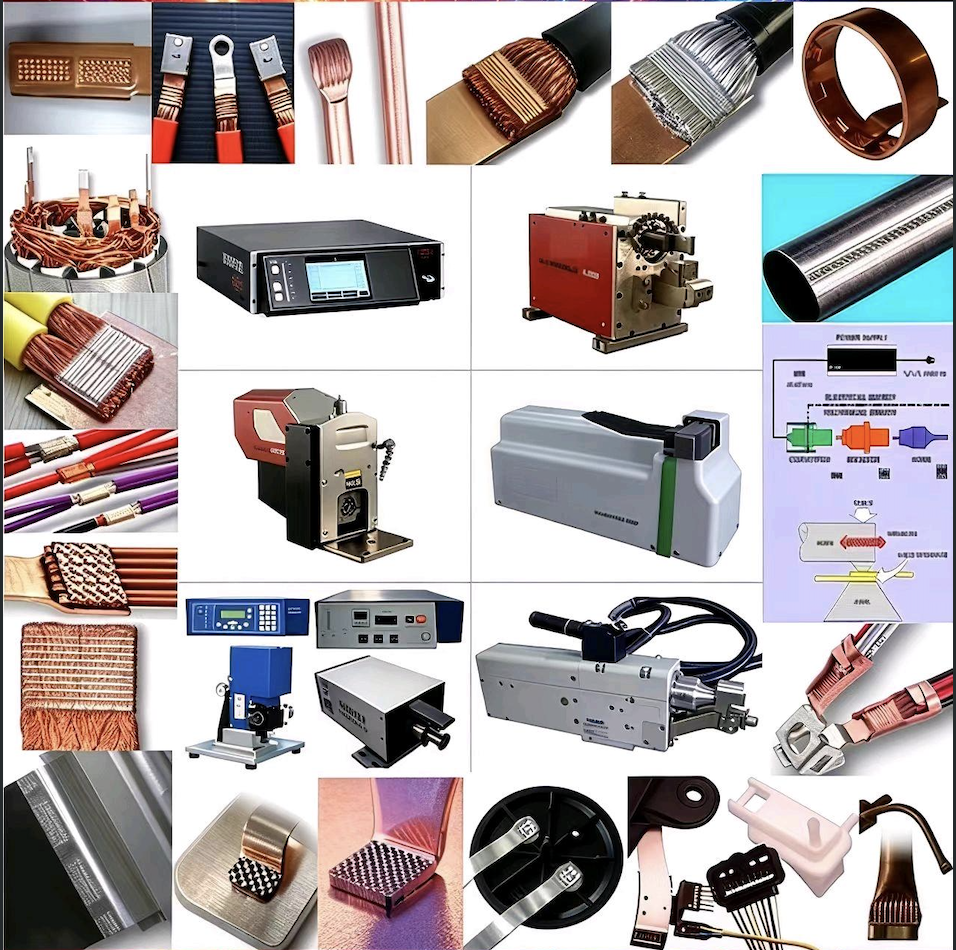
Ultrasonic welding is ideal for small, complex and precision components, including wires, circuits, metal sheets, foils and mesh parts. It is not suitable for extra-thick workpieces (especially thick metal workpieces, which cannot achieve reliable solid-state bonding due to limited vibration penetration), but excels in automated, high-precision mass production. Its core application industries are as follows:
1. Electronics & Electrical Industry
Widely used for precision bonding of micro circuits, wire harness connection, flash drive storage component assembly and battery module welding, ensuring particle-free and low-heat assembly for electronic products.
2. Automotive & Aerospace Industry
In automotive manufacturing, it assembles plastic interior parts (dashboards, door panels, steering wheels) and engine electrical components. In aerospace, it bonds lightweight thin aluminum plates, carbon fiber composites and other high-performance materials, meeting lightweight and high-strength industrial standards.
3. Medical Device Industry
With zero contamination and no material degradation during welding, the technology is suitable for manufacturing sterile medical supplies, including blood filters, medical masks, patient gowns and transdermal patches, complying with strict medical production specifications.
4. Packaging Industry
Applied to the sealing and assembly of special packaging for hazardous materials (fireworks, explosives, active chemicals), as well as daily food packaging (milk containers) and daily necessities (butane lighters), realizing high-speed and hygienic packaging sealing.
FAQs About Ultrasonic Welding
1. What materials can be ultrasonically welded?
It supports soft and rigid thermoplastics, thermoplastic composite materials, as well as various metals including aluminum, brass, copper, precious metals and nickel alloys. It also enables reliable welding of dissimilar metal combinations.
2. Is ultrasonic welding waterproof and airtight?
Ordinary ultrasonic welding joints do not have natural waterproof or airtight performance. However, by optimizing the welding structure, wall thickness, material selection, ultrasonic frequency and power parameters, it can fully meet the waterproof and airtight requirements of products such as water tanks, coffee makers and vacuum cleaner housings.
3. Is ultrasonic welding dangerous?
Ultrasonic welding is far safer than traditional welding processes. It requires no high-temperature heating, produces no harmful smoke or exhaust, and features targeted energy output with no redundant electrical risks, ensuring safe industrial operation.
4. Does ultrasonic welding generate heat?
High-frequency low-amplitude mechanical vibrations generate localized frictional heat at the welding interface. The heat is sufficient to melt thermoplastic materials for bonding, but not enough to melt or damage metal base materials.
5. What is the frequency range of ultrasonic welding?
The standard frequency range of industrial ultrasonic welding is 20kHz to 70kHz. The nominal ultrasonic frequency threshold is 20kHz, which is the upper limit of typical human hearing. While the 20kHz fundamental vibration itself belongs to ultrasonic waves and is mostly inaudible to humans, audible noise may still occur from sub-harmonic vibration and mechanical resonance of fixtures or workpieces. Frequencies above 20kHz effectively avoid such audible noise interference in most working scenarios.
Conclusion
Ultrasonic welding is a high-efficiency, eco-friendly and precise solid-state joining technology that utilizes high-frequency ultrasonic vibration energy. By applying controlled ultrasonic vibrations and stable pressure to clamped workpieces, it realizes local melting and firm bonding of soft and rigid thermoplastics, composite materials and thin-layer metals without melting the base materials or using any adhesives or fillers.
With the advantages of low temperature, fast speed, high precision, safety and automation compatibility, ultrasonic welding has become an indispensable core process in automotive, aerospace, medical, electronics, packaging and other industries. As a professional ultrasonic welding solution provider, MCSONIC delivers customized ultrasonic welding, cutting equipment and mature industrial solutions for global manufacturers, supporting high-quality and low-cost production upgrading.


